ankerl::unordered_dense is my C++ hash map. It
has been stable for years, and this summer it got the most performance work since I wrote it.
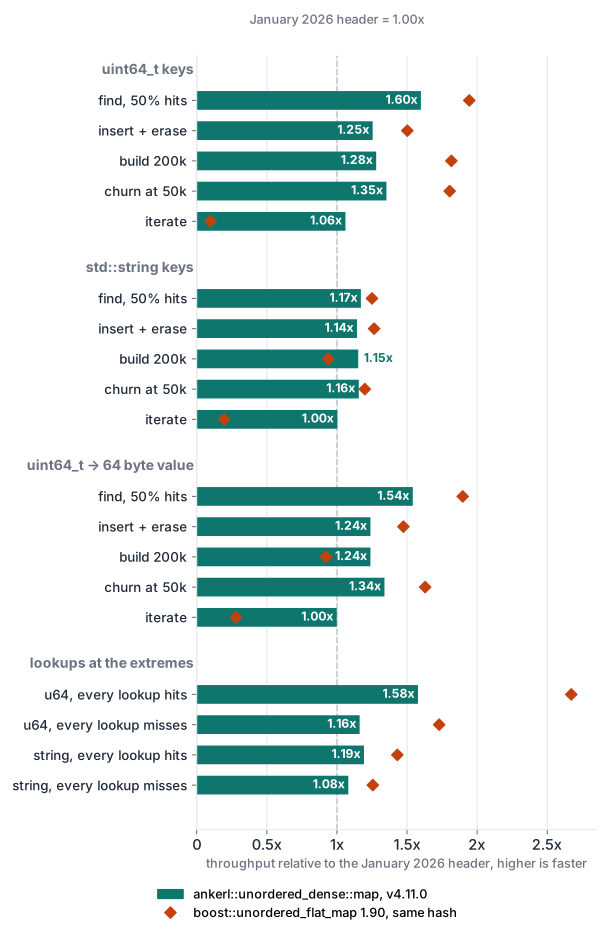
Random lookups with integer keys run 1.6x faster than they did in January, insert and erase
1.25x, and the string find, insert, build and churn workloads gained 14 to 17%. Most of that comes from one idea: the
probe now reads four buckets at once with SSE2 instead of one at a time, and the insert and
erase paths do the same with their shifting.
This post is the whole story: how the map is laid out, why the old lookup was slow, what SSE2
actually does (in enough detail that you can read the code without having used it before), how
the numbers were measured, how it compares to boost::unordered_flat_map, and the list of
things that did not work. The benchmark also lied to me several times along the way, and
those are worth telling too.
All measurements are on a Ryzen 9 7950X with clang 22 at -O3, default -march (so plain
x86-64: SSE2 and nothing newer), and Boost 1.90 with the same hash function on both sides.
What a dense map looks like
The map is two arrays. The values live in a std::vector<std::pair<Key, T>> in insertion order,
which is what makes iteration a plain array walk and is where the “dense” in the name comes from.
The hash table proper is a separate array of 8 byte buckets, and a bucket holds no key at
all: only where its value is, and enough of the hash to avoid going there for nothing.
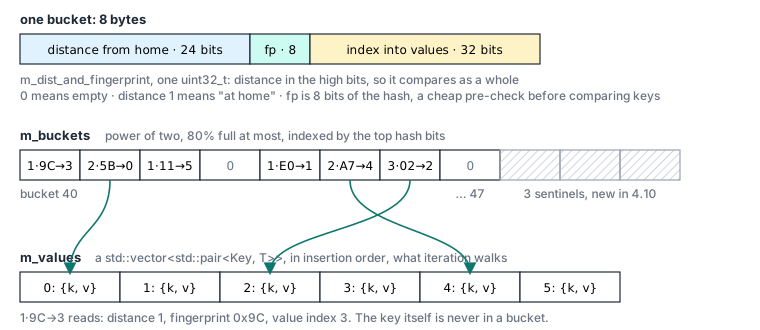
The first 32 bits of a bucket, m_dist_and_fingerprint, pack two things. The low byte is a
fingerprint, 8 bits of the hash. The high 24 bits are the distance from the bucket the key
originally hashed to, its home: a key sitting at home has distance 1, a key pushed one bucket
along has distance 2, and 0 means the bucket is empty. Because the distance is in the high bits,
one integer compare orders buckets first by distance and then by fingerprint.
The table is a robin hood table:
along any run of occupied buckets, distances never drop by more than one, and an insert that
finds a bucket occupied by a key closer to its home than we are to ours takes the bucket and
pushes that key on. This invariant is what makes an unsuccessful lookup cheap. Walking from the
home bucket, we carry the dist_and_fingerprint our key would have at each step. The moment a
bucket holds something less than that, we know the key is absent: had it been inserted, it
would have taken this bucket. So a probe has exactly three outcomes per bucket: equal (a
fingerprint match, go compare the key), less (the key is not here, stop), or neither (keep
going).
The lookup, before
Here is the probe as it stood in January, stripped of the unrolling:
while (true) {
    if (dist_and_fingerprint == bucket->m_dist_and_fingerprint) {
        if (m_equal(key, m_values[bucket->m_value_idx].first)) {
            return found;
        }
    } else if (dist_and_fingerprint > bucket->m_dist_and_fingerprint) {
        return not_found;                 // robin hood: nothing further can be ours
    }
    dist_and_fingerprint += dist_inc;     // one step further from home
    bucket = &m_buckets[next(bucket_idx)];
}
It is short, it is what I would write again, and it has a problem that took me embarrassingly long to see: it branches once per bucket, and the answer at each bucket is a coin flip.
A modern CPU does not wait to see where a branch goes. It guesses, runs ahead on the guess, and if the guess was wrong it throws away everything it did since and starts over, which on this machine costs around 16 cycles. The guess comes from a predictor that learns patterns in the history of branch outcomes, and it is remarkably good at anything with a pattern. But where in the chain a key turns up has no pattern. Most keys sit at home, some one bucket along, a few two. Every lookup replays the same two branches and the predictor has nothing to learn from.
perf stat puts a number on it. Ten million lookups of keys that are all in a map of 50000
uint64_t entries:
$ perf stat -e cycles,instructions,branches,branch-misses ./perfrun base hit
   754,455,827  cycles
   582,677,522  instructions
    85,773,145  branches
    11,350,176  branch-misses
That is 1.14 mispredictions per lookup. The same workload against boost::unordered_flat_map
gives 0.12. At 16 cycles each, the mispredictions alone are 18 of the 75 cycles a lookup takes
here, and they hurt more than that, because a mispredict also drains the pipeline of the
next lookup that out-of-order execution had already started.
Boost’s number is low because its probe does not ask one bucket at a time. It loads a group of metadata, compares all of it in one instruction, and branches once on the result. The outcome of that branch does not depend on where the match was, only on whether there was one, and for a lookup that hits the answer is nearly always yes. I wanted that property, and the bucket layout above turns out to allow it.
SSE2, for people who have never used it
SSE2 is the vector instruction set that every x86-64 CPU has had since the first one in 2003, so it needs no compiler flag and no runtime check. It gives you sixteen 128 bit registers and instructions that treat a register as several lanes of the same width and do the same thing to every lane at once. Four 32 bit lanes is the width that matters here, because a bucket is two 32 bit fields and a lookup wants to examine four of them.
In C++ you reach these through intrinsics: functions from <emmintrin.h> that map one to one
onto instructions, with a __m128i type for a register holding integers. Intel’s
Intrinsics Guide
documents every one of them, with the exact lane semantics. Every one used in the
map is in this table, and there are only a dozen.
| intrinsic | what it does |
|---|---|
_mm_loadu_si128(p) |
load 16 bytes from p, any alignment |
_mm_storeu_si128(p, v) |
store 16 bytes |
_mm_set1_epi32(x) |
put x in all four lanes |
_mm_setr_epi32(a,b,c,d) |
four lanes with four values, in that order |
_mm_add_epi32(a, b), _mm_sub_epi32 |
add or subtract, lane by lane |
_mm_cmpeq_epi32(a, b) |
lane by lane: all ones where equal, all zeros elsewhere |
_mm_and_si128, _mm_or_si128, _mm_andnot_si128 |
bitwise, over all 128 bits |
_mm_shuffle_ps(a, b, sel) |
build a register from any two lanes of a and any two of b |
_mm_slli_si128(v, n), _mm_srli_si128 |
shift the whole register by n bytes |
_mm_movemask_ps(v) |
take the top bit of each lane and pack them into a 4 bit integer |
Two of these carry the whole design. _mm_cmpeq_epi32 turns a question into a lane full of
ones or zeros, and _mm_movemask_ps turns four lanes into four bits of an ordinary integer,
where countr_zero (the tzcnt instruction) tells you the lowest set bit in one step. Ask
four questions with one instruction, get four answers as an integer, pick the first yes: that is
the entire trick. Everything else is plumbing.
One oddity you will see in the code: _mm_movemask_ps and _mm_shuffle_ps are officially
float instructions, so the integer register gets cast to __m128 and back with
_mm_castsi128_ps. The casts compile to nothing. SSE2 simply never got an integer version of
those two, and the float ones do exactly what is needed on 32 bit lanes.
The probe, four buckets at a time
A lookup now loads the four buckets starting at the key’s home, and for each lane compares
against what the key would carry in that bucket: its dist_and_fingerprint at home in lane 0,
one distance more in lane 1, and so on. Equal is a fingerprint match. Less is the robin hood
proof of absence. The lowest lane that is either decides, and it is found with one
countr_zero.
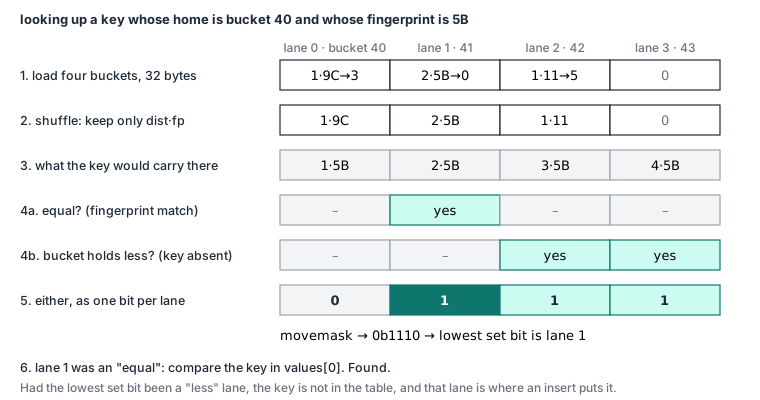
Reading the buckets is the first bit of plumbing. Two loads fetch four buckets, but each 16 byte
load holds two whole buckets, so its four lanes are [dist·fp, index, dist·fp, index], and
the compare wants the four dist·fp values side by side in one register. That is a shuffle:
template <int Field>   // 0: m_dist_and_fingerprint, 1: m_value_idx
static auto gather(Bucket const* gp) -> __m128i {
    // d = dist·fp, i = index; lanes written low to high, lane 0 first
    auto lo = _mm_loadu_si128(reinterpret_cast<__m128i const*>(gp));      // [d0 i0 d1 i1]
    auto hi = _mm_loadu_si128(reinterpret_cast<__m128i const*>(gp + 2));  // [d2 i2 d3 i3]
    // result lanes 0 and 1 come from lo, lanes 2 and 3 from hi. With Field = 0:
    // lo[0] lo[2] hi[0] hi[2] = [d0 d1 d2 d3]. With Field = 1: [i0 i1 i2 i3].
    return _mm_castps_si128(_mm_shuffle_ps(_mm_castsi128_ps(lo), _mm_castsi128_ps(hi),
                                           _MM_SHUFFLE(2 + Field, Field, 2 + Field, Field)));
}
So gather<0> returns the four dist·fp values, [d0 d1 d2 d3], and gather<1> the four
indices. The selector needs a word, because _MM_SHUFFLE reads backwards. _mm_shuffle_ps
always fills result lanes 0 and 1 from its first argument and lanes 2 and 3 from its second; the
selector says which lane of that argument each one takes, and the macro takes them in the
order _MM_SHUFFLE(lane3, lane2, lane1, lane0), highest first, the way you would write the bits
of a number. So _MM_SHUFFLE(2 + Field, Field, 2 + Field, Field) means: lane 0 of the result is
lo[Field], lane 1 is lo[2 + Field], lane 2 is hi[Field], lane 3 is hi[2 + Field]. Read
left to right it looks like it starts with the high lane, and it does, because that is the
macro’s convention and not the data’s.
With that, the probe is this. I have left out the casts and the NOLINTs; the real thing is
probe_simd in the header, and the change
as a whole is PR #211.
The step numbers in the comments are the ones in the figure above.
// Step 3, done once: what the key would carry in each of the four buckets from home.
// set1 puts the key's dist·fp in all four lanes; setr adds 0, 1, 2, 3 distances to them,
// so with dist·fp = 1·5B the lanes hold [1·5B 2·5B 3·5B 4·5B].
auto expected = _mm_add_epi32(_mm_set1_epi32(dist_and_fingerprint),
                              _mm_setr_epi32(0, dist_inc, 2 * dist_inc, 3 * dist_inc));
auto const step = _mm_set1_epi32(4 * dist_inc);   // four more distances, for the next window

while (true) {
    // Steps 1 and 2: the four buckets from bucket_idx, and their dist·fp side by side.
    auto const* gp = m_buckets.data() + bucket_idx;
    auto d = gather<0>(gp);                     // [d0 d1 d2 d3]

    // Step 4a: a lane is all ones where the bucket holds exactly what the key would carry
    // there, which is a fingerprint match at the right distance.
    auto eqv = _mm_cmpeq_epi32(d, expected);
    // Step 4b: a lane's top bit is set where the bucket holds *less*, because the subtraction
    // went negative. That is the robin hood proof that the key is absent.
    auto lessv = _mm_sub_epi32(d, expected);
    // Step 5: movemask takes the top bit of each lane and packs them into an integer, bit 0
    // for lane 0. `candidates` has a bit for every lane that decided either way, `less` only
    // for the "absent" ones.
    auto candidates = _mm_movemask_ps(_mm_castsi128_ps(_mm_or_si128(eqv, lessv)));
    auto less       = _mm_movemask_ps(_mm_castsi128_ps(lessv));

    if (candidates != 0) {
        // Step 6: the lowest lane that decided is the answer, because buckets further along
        // cannot hold the key if an earlier one already proved it absent.
        auto j = countr_zero(candidates);       // 0b1110 -> 1
        if ((less >> j) & 1) {
            // that lane said "less": the key is not in the table, and this is where an insert
            // would put it
            return not_found_at(bucket_idx + j);
        }
        // that lane said "equal": a fingerprint match, so compare the actual key
        auto value_idx = gp[j].m_value_idx;
        if (m_equal(key, m_values[value_idx].first)) {
            return found(value_idx);
        }
        // fingerprint collision, rare: carry on one bucket at a time from lane j + 1
        return probe_scalar(key, /* from lane j + 1 on */);
    }
    // nothing decided in these four: the next four buckets, each four distances further
    bucket_idx += 4;
    expected = _mm_add_epi32(expected, step);
}
A few things worth pointing at:
- “Less” costs no compare. Both values are far below 231, so
bucket - expectedis negative exactly when the bucket holds less, and_mm_movemask_psreads sign bits. One subtraction gives the “less” lanes, one compare gives the “equal” lanes, anorgives “either”, and both masks come out as integers. - One data dependent branch.
candidates != 0is almost always true: a chain longer than four buckets is rare at 80% load. The branch that follows, hit or miss, is the caller’s own uncertainty, and it would have been paid onit != end()anyway. What is gone is the branch per bucket, the one whose outcome depended on the position of the hit. - The array grew three sentinel buckets. A window of four read from the last bucket would
run off the end, so the array carries three extra buckets that hold a
dist_and_fingerprintno key can expect and no real bucket can be less than. A window passes over them as it would over occupied buckets that are not the answer, and only where a window decides nothing does the probe wrap to bucket zero, by handing over to the scalar probe.bucket_count()does not count them. - The key comparison happens outside the vector code. On a fingerprint collision, the rare
case where the fingerprint matched but the key did not, the probe continues in the scalar loop
from the next bucket rather than going back around. An earlier version kept the vector state
alive across the key comparison, and for string keys that made the compiler spill all of it
around
bcmpon every hit. - Not every configuration gets this. The vector probe needs the default
std::vectorbucket storage and the standard 8 byte bucket. The segmented and custom bucket containers, the big bucket type, and non-x86 targets keep the scalar path. ARM has the same four lane compares in NEON and is the obvious next step.
What it bought
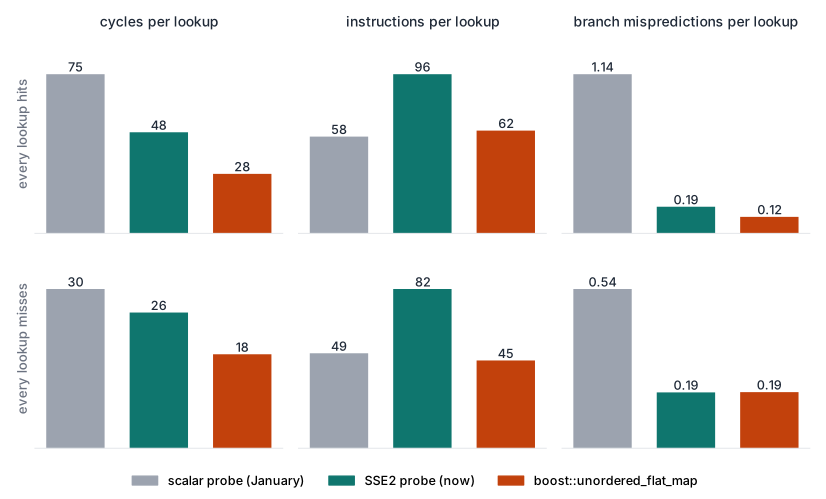
Per lookup, all hits, the mispredictions went from 1.14 to 0.19, the instructions from 58 to 96, and the cycles from 75 to 48. That instruction count is the price: the vector probe’s irreducible core is about sixteen instructions before it can decide anything, where the scalar probe’s first bucket was three. It is a trade of instructions for mispredictions, and the model that predicted every variant I tried to within a cycle or two is
cycles per operation ≈ 16 × mispredictions + instructions / 3.5
which is what says 38 more instructions are worth paying for 0.95 fewer mispredictions. That model was fit on tables that sit in L2. The 50000 entry table here is bigger than that, and the saving is larger than the model predicts, because a branch that waits on a slow load and then turns out to be wrong also throws away the next lookup’s loads, which the CPU had already started. On lookups that all miss the trade is smaller, because the scalar probe usually stopped at the first bucket and had less to mispredict. On the benchmark’s find workload, half hits and half misses against a map growing to 50000 entries, it is 1.6x over January.
The same window serves inserts (try_emplace probes first, and where the probe stops is where
the key goes) and erases, and it fixed the last part of an erase too. Erasing swaps the last value
into the hole it leaves in the values vector, so the bucket pointing at that last value has to be
found and repointed. That scan now matches value indices four at a time with gather<1>.
The same trick for inserting and erasing
With the probe done (PR #213 has the rest of this section), perf said
inserts and erases were still paying 0.6 mispredictions each,
and the branch was in the robin hood shift. Placing a key into an occupied bucket pushes the
occupant along, and that one may push the next; the loop asks “is this bucket occupied” once per
bucket. Measured over eight million inserts into a table at its load factor, 73% shift nothing,
11% shift one bucket, and the rest tail off. A coin flip per bucket, again.
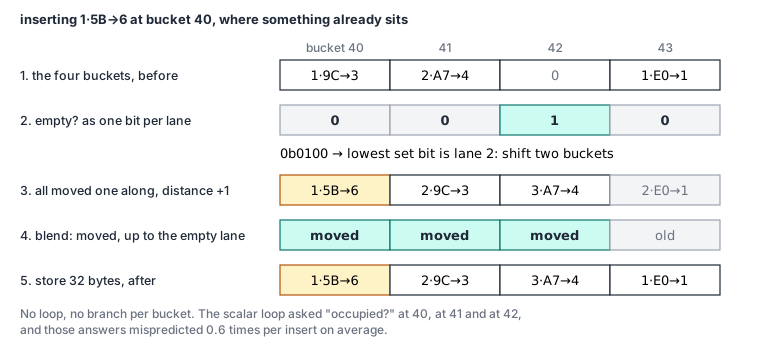
The vector version reads the four buckets at the place, asks “empty?” of all four with one
compare, and countr_zero on the mask says how long the run of occupied buckets is: 0 to 3. Then
it builds what the window would look like if every bucket moved one along. _mm_slli_si128
shifts the whole register by 8 bytes, which moves bucket 0 into bucket 1’s position in one
instruction; the new bucket is ored into lane 0, and a lane of dist_inc constants adds one
distance to every bucket that moved:
auto empty = _mm_movemask_ps(_mm_castsi128_ps(_mm_cmpeq_epi32(dists, _mm_setzero_si128())));
if (empty != 0) {
    auto run = countr_zero(empty);            // occupied buckets before the first empty: 0..3
    // [new, b0, b1, b2], the old ones one distance further from home
    auto moved_lo = _mm_add_epi32(_mm_or_si128(_mm_slli_si128(lo, 8), fresh),
                                  _mm_setr_epi32(0, 0, inc, 0));
    auto moved_hi = _mm_add_epi32(_mm_or_si128(_mm_slli_si128(hi, 8), _mm_srli_si128(lo, 8)),
                                  _mm_setr_epi32(inc, 0, inc, 0));
    // lanes 0..run take the moved contents, the rest keep what they had
    auto keep_lo = keep[run].lo;              // all ones in the lanes that move
    auto keep_hi = keep[run].hi;
    lo = _mm_or_si128(_mm_and_si128(keep_lo, moved_lo), _mm_andnot_si128(keep_lo, lo));
    hi = _mm_or_si128(_mm_and_si128(keep_hi, moved_hi), _mm_andnot_si128(keep_hi, hi));
    _mm_storeu_si128(gp, lo);
    _mm_storeu_si128(gp + 2, hi);
    return;
}
// a run of four or more, or the last buckets before the sentinels: the loop as before
The last three lines before the stores are a blend: (mask & new) | (~mask & old), lane by
lane. SSE4.1 has an instruction for that; SSE2 does it with three. The masks come from a tiny
constant table indexed by run, four rows of 32 bytes.
Erase is the mirror image. The four buckets after the victim are read, “is this bucket displaced” (distance two or more) is asked of all four at once, the run of displaced buckets moves back by one with distance one less, and the bucket where the run ends becomes the empty one. This is backward shift deletion, which leaves the table exactly as if the erased key had never been inserted, and it is the reason there are no tombstones anywhere in this map.
Per operation on a reserved table of 200000 uint64_t keys, hardware counters over eight
million of each:
| mispredictions | cycles | instructions | |
|---|---|---|---|
| insert, scalar shift | 0.61 | 52.4 | 101.5 |
| insert, vector shift | 0.24 | 46.3 | 126 |
| erase, scalar shift | 0.60 | 63.6 | 106.4 |
| erase, vector shift | 0.26 | 54.5 | 132.7 |
Same shape as the probe: more instructions, fewer mispredictions, fewer cycles. The gain grows with the chains there are to shift, so it is 27% on a table erased from full to empty at 10000 entries and 7% at 200000. A two lane version was tried first and lost to this one, because its second slot was still a branch.
Compared with Boost’s flat map
Boost’s flat map is the container I measure against, because it is the fastest open addressing table I know of and because its design is the other answer to the same question. It is a SwissTable descendant: slots are grouped in fifteens, each group has a 16 byte metadata word, and a lookup compares the whole word against the key’s reduced hash in one instruction.
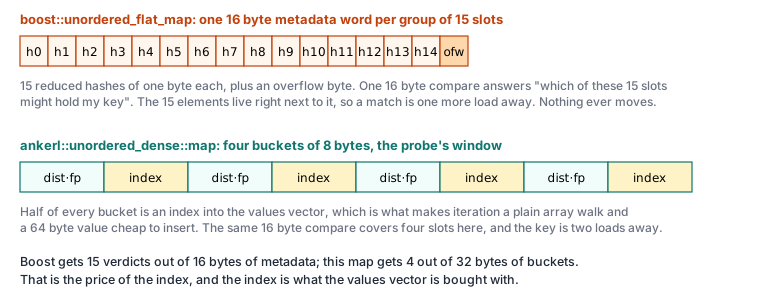
Put side by side it is clear why Boost wins a fresh lookup. One 16 byte compare gives it 15 verdicts; this map’s 32 byte window gives 4, because half of every bucket is the index into the values vector. Boost’s keys also live right next to the metadata, one load away, where here a hit is bucket, then index, then value: two dependent loads. On lookups that all hit Boost is at 28 cycles against this map’s 48, and 1.21x ahead on the benchmark’s 50/50 find. That is what is left of the gap after this summer, down from 1.94x in January.
Boost also never moves an element once placed. There is no robin hood, no shift on insert and no shift on erase. That is why an insert into Boost costs only 0.10 mispredictions; the vector shifts brought this map from 0.61 down to 0.24, better, but still above a table that has nothing to shift. So on a fresh table Boost is ahead on every lookup and insert workload with small values, and it is worth being clear about that.
What the index buys is everything else:
- Iteration. The values are a vector. Boost walks its groups, and on the benchmark’s iterate-while-modifying workloads it runs at 10 to 28% of this map’s speed.
- Large values. A flat map writes the whole value into a hash scattered slot, and every
cost it has scales with
sizeof(value_type). A dense map writes 8 bytes there and appends the payload in order. With a 64 byte mapped value, building 200000 entries is 1.3x faster here than in Boost, and peak memory for a million entries is 101 MB against 205. - Strings. Building a map of 200000 string keys is 1.23x faster here, for the same reason
in a smaller way:
std::stringis 32 bytes. - A table that only churns. Boost’s erase frees the slot, but it cannot clear the overflow bits that inserts probing past the group left behind, so its unsuccessful lookups probe further and further as a table churns until a rehash cleans up. Measured on a table held at 200000 entries by erasing one and inserting one: Boost’s lookups degrade to 1.31x of their fresh cost and snap back on an in-place rehash it pays for every third round, while this map’s stay flat within the noise for two million operations. That is backward shift deletion doing what it promises, and it narrows the gap from 1.71x on fresh all-hit lookups to 1.32x on sustained churn.
Neither map is the right one for every workload, which is why I built
a quiz about that a few days ago rather than another ranking. The comparison is
fair in one respect that matters: both maps use this library’s hash, and Boost’s
hash_is_avalanching trait is honoured, so it skips its own mixing step exactly as it would for
its own hash. That interop is one of the smaller changes.
The hash
Three changes to the string hash, a descendant of wyhash, all from July (#165 and #166):
- Six lanes for long inputs. The main loop processed 48 bytes per iteration with three independent accumulators; it now does 96 with six, which halves the length of the multiply chain for keys over 192 bytes. Below that the extra accumulators cost more to set up and fold than they save, so the threshold was moved up after measuring it.
- An independent tail. The final mix used to depend on the seed chain. For inputs over 48 bytes the last 16 bytes are now mixed with secret constants only, so that work runs in parallel with the lane loops and a single dependent mix finishes.
- Two 8 byte reads for 8 to 16 byte keys, overlapping, instead of assembling the two words from four 4 byte reads with shifts. This is what rapidhash does for short inputs, and it was the one place rapidhash was ahead; for anything over 24 bytes the hash here is faster than rapidhash v3, which is why it was not swapped for it.
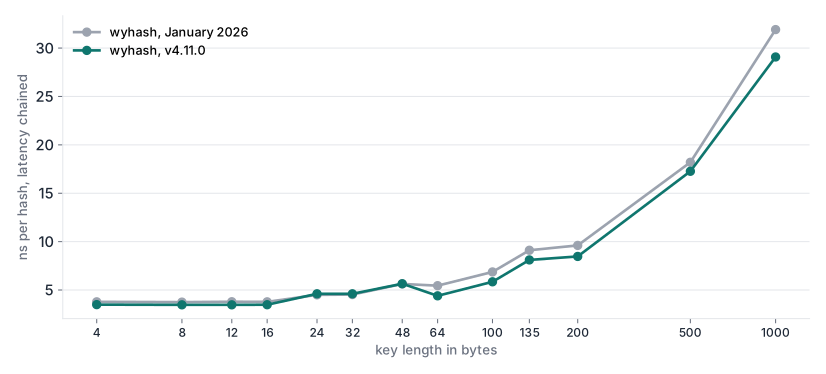
Latency chained, each hash waiting on the previous one, it is 8% faster for short keys, 11 to 19% faster for 64 to 200 bytes, and 9% at a kilobyte. Hashing is a third of a string lookup, so this is where a good share of the string workloads’ 15% came from.
The benchmark lied, five times
The score I optimise for is the geometric mean of fifteen workloads. It is a single number, which makes it easy to chase, and it turned out to be measuring the wrong things in several ways at once. Each of these was found because a change that should have helped did not, and each changed what the benchmark rewards.
- The find workload replayed. Its search rng was reset to the insertion rng’s seed, so its sequence of hits and misses repeated every run, and a branch predictor with a long history learned half of it: 0.6 mispredictions per lookup where a random sequence costs more than double. That rewarded branchy probing and hid most of what the SSE2 probe gains. The workload now decides every lookup with an rng of its own (#211).
- Every string key was 200 bytes. The hash dispatches on length, and one length makes that dispatch perfectly predictable: 0.01 mispredictions per hash on a fixed length against 0.31 on lengths spread from 4 to 200. It also put every key on the heap. Keys now run from 8 to 135 bytes, skewed short, the way real keys are (#213).
- The integer keys hashed to a lattice. The insert-erase workload used small sequential
values as keys, and the hash of a
uint64_tis one multiply, so the top bits of multiples of a small integer walked a lattice: 10000 keys landed at most one to a bucket, 82% of erases moved nothing, and the vector shifts above first read as losses. Keys are now scrambled through a bijection first (#213). - Nothing grew a table. Building a map of a million entries costs 52% more than building
it after a
reserve, all of it rehashing, and no scored workload paid it. A build-from-empty workload was added, and it showed at once that growth is where this map is weakest against Boost (#213). - Nothing churned. Every workload measured a fresh table, which is systematically kind to a design that trades erase quality for lookup speed. The churn workload above was added, and it is the one where backward shift deletion gets to show what it is for (#215).
And a sixth that was not the benchmark’s fault: the build workload was measuring the kernel. A
build asks for megabytes and gives them back, glibc returns anything above its mmap threshold to
the OS, and every repetition faulted the same pages in again: 38% of the cycles were kernel
time, at 2000 page faults per build, and whether it was paid depended on what had run before
in the process. Raising M_MMAP_THRESHOLD and M_TRIM_THRESHOLD so the arena is kept took the
build from 6.6 ms to 3.8 ms and made the number the same whatever ran first
(#216).
What did not work
The list is long, and it is in
CLAUDE.md
in the repository with the measurements, so that neither I nor anyone else re-tries them without
new evidence. The ones that taught me something:
- Force-inlining the hash into the map: icache and register pressure cost more than the call saved.
- A branchless scalar lookup, unconditional key compare plus a conditional move: the speculative value load doubled the cache misses on the half of lookups that miss. Catastrophic, 1.6x slower.
- Prefetching the value in the probe, or the moved element’s home bucket in erase: out-of-order execution already hides those latencies.
- An AES-NI hash (a port of gxhash): 30% slower on 200 byte keys. Its serial
aesencchain has worse latency, and latency is what the string loop pays for. Fewer instructions do not help a chain. - Aligned groups of four instead of a window starting at home: left the “nothing decided, next group” branch random. Two branches to decide (scalar home bucket, then the vector for the rest): mispredicted more than one vector decision, although each branch is more biased.
- Four attempts at the rehash loop (#217). It costs 21 to 26 cycles per element at every size from L1 to L3, and what bounds it is not memory but an in-core chain: each element’s loads sit behind the previous element’s stores through the bucket array. Adding 11 cycles of artificial latency between the probe load and the store address added 17 cycles per element. Nothing that shortens the data side of a store moves it, and vectorising the probe there made it 1.4x slower, because the store address then waited on the window load.
Also this summer
Not everything was about speed. Reserving, rehashing and growing on insert all used to release the old bucket array before asking for the new one, so a failed allocation left values with no buckets to find them by; they now build the new array first, and a failure leaves the table exactly as it was (#182). The segmented vector’s allocator handling was fixed, and Daniel Kral found and fixed a quadratic case in its block index growth. There is a mutation testing tool now, which found seven promises the tests were not checking; the fuzz targets run under libFuzzer and AFL++ nightly; and there is a valgrind leg in CI. Releases: 4.9.0 through 4.9.2 in August, 4.10.0 with the SSE2 probe and 4.11.0 with the vector shifts in September.
How this was measured, and how you can
The tool I would not do this without is a paired, interleaved A/B.
scripts/ab/run.sh in the repository builds the working tree’s header against any git revision of itself in one
binary, by renaming the baseline into a second namespace, and runs both on the same workloads
interleaved in the same slice of time with nanobench’s
compare(). Machine drift cancels out of the ratio and you get a confidence interval on it. A
desktop drifts by a few percent over minutes, and run-to-run noise is 1 to 2%, so anything
under 5% measured the old way, before and after in separate runs, is a coin flip. Every number
in this post with an “x” on it came out of that harness, with the January header as the
baseline and Boost as a third contender:
The second tool is perf stat with
-e cycles,instructions,branch-misses on a runner that does one
workload and nothing else. It is what separates “more instructions” from “more mispredictions”,
and with the cost model above it predicted the outcome of most experiments before the A/B
confirmed them. Two cautions from using it. A harness that erases the same keys in the same
order every repetition reports 0.003 mispredictions per erase and no gain from any of this,
because the predictor learns the order; shuffle per repetition. And a tight loop with nothing in
it but the function under test resolves large changes only: the hash microbenchmark in the A/B
reported the new hash 10% slower in the paired binary and 8 to 20% faster in separate ones,
because which of the two gets the better code layout mattered more than the hash. Check small
changes against the map workloads, where the hash is a third of the work and layout luck
averages out.
The code is at github.com/martinus/unordered_dense. If you have an ARM machine and an afternoon, the NEON port of the four lane window is waiting.